
Ibn Kathir
Arab exegete and historian, author of Tafsir Ibn Kathir.

KneeHallHawk · CC0
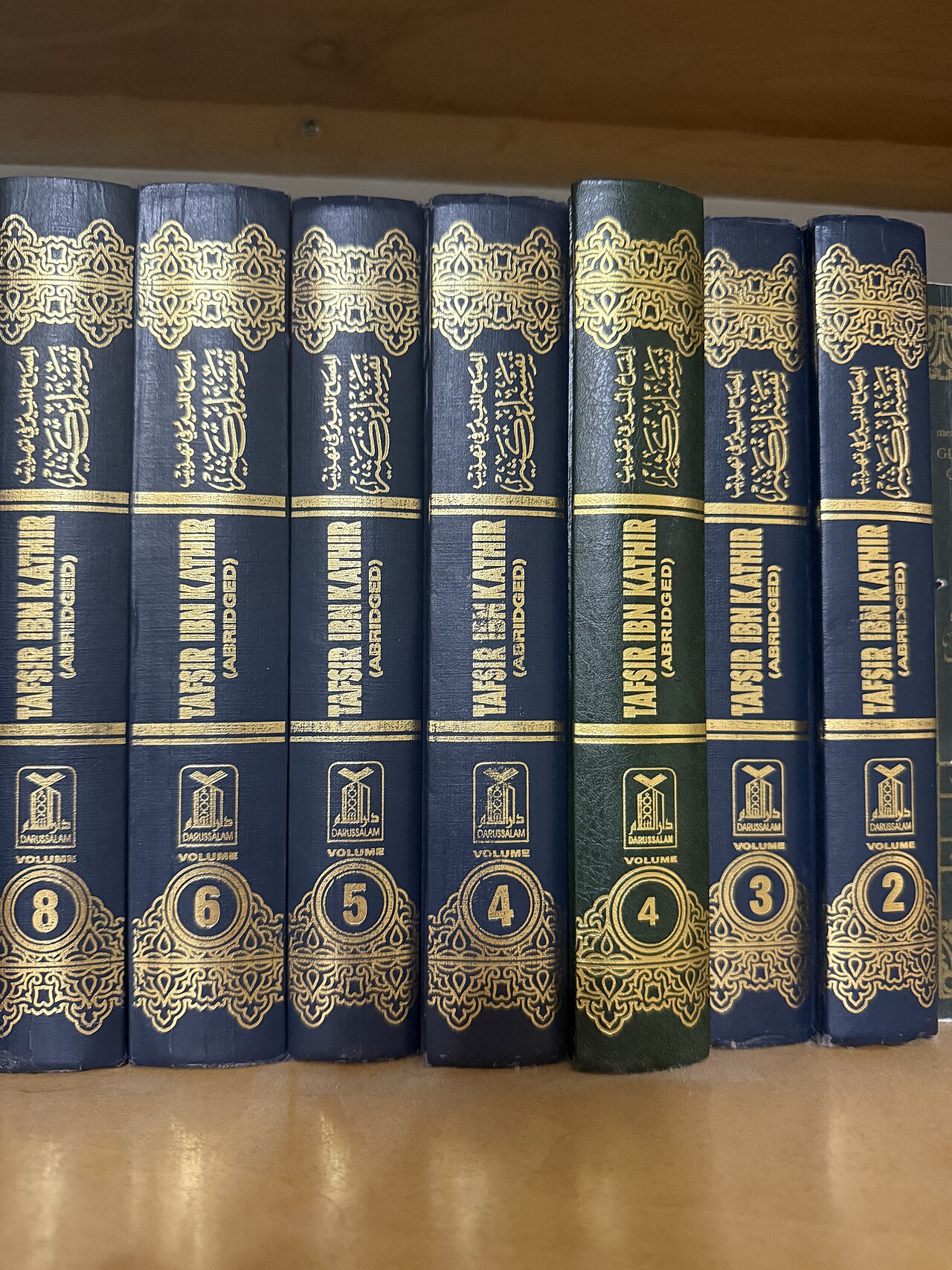
He is considered a leading authority on Sunni Islam, particularly known for his fourteen-volume universal history al-Bidaya wa'l-Nihaya and his influential tafsir, Tafsir Ibn Kathir, which is noted for its critical approach to Israʼiliyyat.
- died
- February 1373 in Damascus
- field
- Tafsir, history, Islamic jurisprudence
- nationality
- Arab, Mamluk Sultanate
- known_for
- Tafsir Ibn Kathir, al-Bidaya wa'l-Nihaya, adherence to Athari theology
Lore & Background
He lost his father at age three and received his first lessons in Islamic jurisprudence from his elder brother, Kamal al-Din abd al-wahhab. His teachers included Ibn Taymiyya and al-Dhahabi. He married the daughter of Al-Mizzi, a leading Syrian scholar, which gave him access to the scholarly elite.
Reader's Guide
Ibn Kathir's significance lies in his influential tafsir, which is recognized for its critical approach to Israʼiliyyat and its reliance on the methodology of his teacher Ibn Taymiyya. He adhered to the Athari school of Islamic theology, rejecting rationalistic theology in favor of strict textualism. His universal history, al-Bidaya wa'l-Nihaya, remains a major reference. In contemporary scholarship, he is widely regarded as an anti-rationalistic, hadith-oriented scholar. His creed has been a subject of disagreement between Ash'arite and Salafi scholars, with some Ash'arites claiming him as an Ash'ari due to his Shafi'i jurisprudence and teaching at Dar al-Hadith al-Ashrafiyya, while others emphasize his alignment with Ibn Taymiyya's traditionist views. He died in February 1373 and was buried next to his teacher Ibn Taymiyya.
Did You Know?
- Ibn Kathir lost his father at age three and received his first lessons in Islamic jurisprudence from his elder brother, Kamal al-Din abd al-wahhab.
- He married the daughter of Al-Mizzi, a leading Syrian scholar, which gave him access to the scholarly elite.
- He became blind in later life, attributing this to working late on the Musnad of Ahmad Ibn Hanbal.
- He died in February 1373 and was buried next to his teacher Ibn Taymiyya.
The Making of a Hanbali Mind
Ibn al-Qayyim al-Jawziyya grew up in a modest scholarly household in Damascus, where his father held the position of superintendent at the Jawziyyah Madrasah, a Hanbali law college that also functioned as a judicial court for the city's Hanbali judge. This setting gave him an early grounding in the Hanbali school of jurisprudence, a tradition in which he would later be ranked among its most significant thinkers. His intellectual formation, however, was profoundly shaped by a sixteen-year apprenticeship under the renowned scholar Ibn Taymiyya, which began when Ibn al-Qayyim was twenty-one and his teacher returned to Damascus from Cairo. Over those years, from roughly 1313 to 1328, the younger man absorbed his mentor's theological and legal positions while also drawing instruction from other masters, including his own father, Ibn 'Abd ad-Da'im, the historian Shams ad-Dīn adh-Dhahabī, and Safi ad-Din al-Hindi. Although he inherited much of Ibn Taymiyya's doctrinal outlook, observers noted that his temperament was considerably less combative. Where his teacher could be confrontational in debate, Ibn al-Qayyim favored a more measured and restrained engagement with opposing viewpoints, a distinction that would come to define his own scholarly voice within the broader Hanbali tradition.
Imprisonment and the Crucible of Faith
The most defining trial of Ibn al-Qayyim's public life came in 1326, when he was arrested and confined alongside his teacher Ibn Taymiyya in the Citadel of Damascus. According to the historian al-Maqrizi, two grievances triggered his detention: a sermon he had delivered in Jerusalem in which he condemned the practice of visiting graves, including the Prophet's burial site in Medina, and his public alignment with Ibn Taymiyya's minority position on a disputed question of divorce that ran counter to the prevailing view among Damascene jurists. The campaign against him drew support across sectarian lines, with Shafi'i and Maliki scholars leading the charge and Hanbali and Hanafi judges lending their authority. Yet the two years of confinement, which ended with Ibn Taymiyya's death in 1328 and Ibn al-Qayyim's subsequent release, proved unexpectedly fertile. Devoting himself to intensive study of the Qur'an, he reported a series of profound mystical experiences, described in the language of direct divine encounter and ecstatic communion. These episodes would later infuse his spiritual writings with a depth that set them apart from purely legal treatises.
Jurisprudential Boldness and Contested Authority
Among his most debated contributions, Ibn al-Qayyim's jurisprudential writings display a striking willingness to expand the tools available to judges and the state. He argued that it was often just to punish a person of lower social standing who made accusations against someone of higher respectability, and he formulated evidential frameworks that reduced a court's dependence on oral testimony. In cases of disputed paternity, he proposed that experts examine the facial features of a child and the alleged father for physical resemblance. In matters of contested impotence, he suggested a judge could obtain a biological sample, reasoning that genuine semen would leave a white residue when heated. Perhaps most controversially, he maintained that physical coercion could be used to extract testimony from suspects he classified as disreputable, a position that ran directly against the long-standing consensus among Islamic jurists that an accused person had the right to remain silent. He also took firm stands against alchemy, divination, and especially astrology, which he viewed as an arrogant attempt to penetrate the secrets of divine wisdom.
Legacy, Students, and a Living Controversy
Ibn al-Qayyim's influence radiated far beyond his own lifetime. His prolific output of doctrinal and literary works made him a touchstone for generations of Muslim scholars during the Mamluk era. Among the most prominent figures who studied under him or were deeply shaped by his thought were the Shafi'i historian Ibn Kathir, the Hanbali hadith specialist Ibn Rajab, and the later polymath Ibn Hajar al-Asqalani. His spiritual legacy is equally significant; his extensive commentary on the Hanbali Sufi Khwaja Abdullah Ansari's treatise Madarij al-Salikin reveals a scholar who could honor a Sufi master while insisting that truth must always take precedence over personal devotion. In the modern era, his name has become a flashpoint in intra-Muslim debates. Many adherents of Salafism regard his medieval critiques of saint veneration, grave worship, and relic practices as a classical intellectual foundation for their own positions, a connection that has made his legacy both celebrated and contested across the Islamic world. He died in September 1350 and was buried beside his father at the Bab al-Saghīr Cemetery in Damascus.
Gallery


Frequently Asked Questions
Who is Ibn Kathir?
He was a 14th-century Arab scholar from the Mamluk Sultanate who specialized in Quranic interpretation, Islamic history, and jurisprudence. He is widely regarded as one of the most authoritative Sunni scholars of his era.
What are Ibn Kathir's most famous works?
His two most celebrated texts are Tafsir Ibn Kathir, a verse-by-verse commentary on the Quran, and al-Bidaya wa'l-Nihaya, a sweeping fourteen-volume history spanning from creation to his own time.
What theological school did Ibn Kathir follow?
He adhered to the Athari (Hanbali) tradition, favoring a straightforward reading of scripture and hadith while steering clear of speculative philosophical elaborations.
Where was Ibn Kathir born and where did he die?
He was born around 1300–1301 in the village of Mijdal, near Busra in present-day Syria, and he passed away in Damascus in February 1373.
Why is Tafsir Ibn Kathir still so widely read today?
It remains a go-to reference for Sunni Muslims because of its rigorous method of filtering out non-Arabic (Israʼiliyyat) narratives and grounding interpretations in hadith and established scholarly consensus.
More in Islamic Scholars & Mystics 1-23
Related in Islamic Scholars & Mystics
Links follow this subject's own source article.
Spotted an error? Know more?
This is a living reference — every entry is fact-audited, and reader corrections feed straight into our audit queue. Suggest an edit · See this site's audit record